
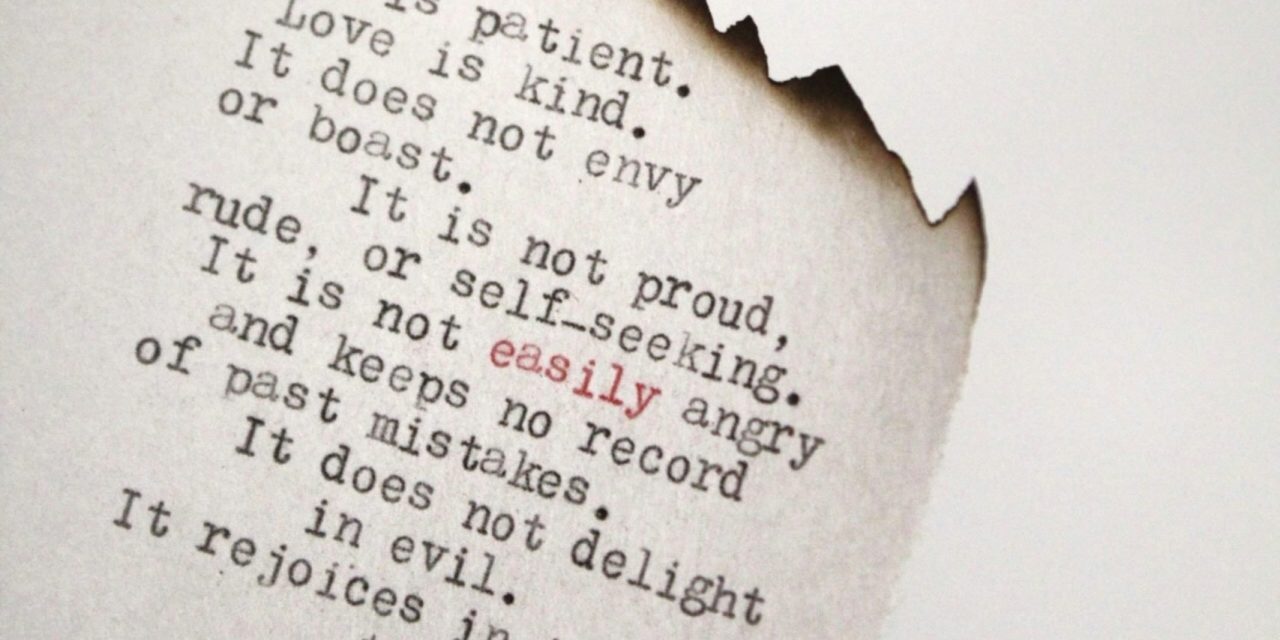
Well, we just survived one of the busiest retail days of the year. Valentine’s Day is an anxious time for many people (not for me, I have a credit card). In one sense it’s easy: blah blah blah flowers, blah blah blah dinner, blah blah blah gift. Blah blah blah love. But of course it’s more complicated than that.
I’ll admit that having a designated day to celebrate love can be a healthy rhythm in our lives if it shifts our attention off ourselves and onto others. At the same time, if we need a day of social pressure to help us love someone, then maybe we aren’t doing it well in the first place.
You likely didn’t notice, but I ended the audio portion of my last blog with the words, I love you. Kind of creepy, I know. How can I say I love you when I don’t even know most of you?
But that’s the thing. As christians, we (technically) shouldn’t have to know you in order to love you. We shouldn’t need to know where you’re from, what you think, or how you live. Wait, what? No conditions on love?
Obviously it’s difficult to love others but we can do it if we choose to. Jesus says so.
Bibles could always be found in various places around the home I grew up in. Like many evangelical families, we attended weekly church services, Sunday School, mid-week studies, as well as church camps and conventions where the Bible was central to the proceedings. That continual exposure ensured my absorption of Bible-knowledge whether I wanted it or not. In fact, when I was barely able to read I memorized Revelation 3:20 because … well, why wouldn’t I?
Evangelical christians are taught that this collection of ancient Judeo-Christian writings is divinely inspired which implies a responsibility to read the Bible and also learn it, believe it, obey it. Unfortunately, most church people don’t actually realize how it came to us or how to interact with it.¹
Through its history too many christians have used Scripture as a blunt force weapon but the Bible has much more to say than the single-minded sermons many are subjected to in church.² Maybe the Bible would be more productive if we used it as a mirror instead of as a sword.
There are a multitude of themes in the Bible that church-goers rarely hear about from their pastors or leaders.³ When we let it breathe for itself, the Bible’s history, literature, metaphors, relationships, stories, arguments, myths, wisdom, can speak past the simple stories and cultural biases … into our hearts and minds.
One of those themes is the underlying standard of love that weaves itself though the hearts of even the darkest biblical stories. Wait, what am I saying? Love is the biggest theme of Scripture.
That was an important point in Matthew 22 when religious leaders tried to corner Jesus with an awkward, open-ended question about the most important rule of life.
“… an expert in religious law, tried to trap him with this question: ‘Teacher, which is the most important commandment in the law of Moses?’
“Jesus replied, ‘You must love the Lord your God with all your heart, all your soul, and all your mind. This is the first and greatest commandment. A second is equally important: ‘Love your neighbor as yourself.’” (NLT)
Jesus’ answer was surprisingly easy … love God with everything you are, then love everything else the way you want to be loved. If he had left his words hanging at that point there may have been further argument but Jesus went on to disarm them with a devastating truth:
“The entire law and all the demands of the prophets are based on these two commandments.”
The entirety of their scriptures – the same scriptures they used to attack and control and manipulate – those same scriptures could be condensed into two simple commands from God about love.
The answer required such insight and purity that overtly religious people had trouble seeing it, and in the end, their weapon of scripture wasn’t a weapon at all.
But if love is so simple, why do christians struggle with it? Why do we insist on enforcing our selected morals and quirky viewpoints while brushing aside the one primary, unified theme of the Bible?
Part of the answer is that love is difficult – really really really difficult. Love is hard because it asks us to give up something from ourselves for the benefit of another. Love is hard because it requires us to let go of the dangerous things we like to cling to: comfort, prejudices, money, winning, even hatred.
Love is also difficult because we must choose it even when it is unpopular. An instruction from 1 John tasks us to love “with actions and truth”. In other words, love can be any size of friendship or kindness but there are times when it requires us to act boldly and bravely in defense of truth.
Love may be difficult but it is also natural for those who live for God. We can do that by reorienting our words, our choices, our actions, our theology, and our hearts toward love. I wonder how healing it would be if christians began to see the image of God in every person and every thing?
Maybe love would be easier if we understood it as the essential element of christian living. Maybe it would be easier if we spent less energy complaining and grasping for love in the emotions of Sunday mornings. Maybe it would be better if we invested ourselves more in discovering the untapped love in the world around us every day.
“God is love”. Take some time to ponder that, it’s in the Bible.
All through it, in fact.
~ ~ ~
¹ In current pop-evangelicalism, the Bible is considered the only source of belief (sola scriptura). That is extremely dangerous when you think about it because it allows biased humans to interpret it as they see fit. (It’s one of the reasons we have more than 45,000 denominations, each claiming unique insight.)
Through history much of the rest of Christianity has been able to hold the Bible more loosely while still valuing it. Even in my own Methodist roots there is a tradition of interpreting belief through the lens of the Bible as well as creation, reason, tradition, and experience.
² “Beware of any Christian movement that acts as though the world is full of enemies to be destroyed rather than full of neighbours to be loved. Beware of any Christian movement that demands the government be an instrument of God’s wrath but never a source of God’s mercy, generosity or compassion.” ~ Rev. Benjamin Cremer on X
³ I couldn’t begin to list them, but for example: benefits of both Temple & Wilderness; the evils of empires; warnings re: money & possessions; dangers of political and religious power; God’s intimacy with Creation; importance of art and music; meanings of the Cross; new heavens and new earth; hiddenness of sin; normalcy of immigration; importance of justice; value of pain; communal responsibility; on and on.
Music: Unknown Album, Grumpynora
Photo by Leighann Blackwood on Unsplash


May I say I Love this blog? 🤔 Joyful to read!